 by husamkaloti
The First Production of The Freedom Theatre School
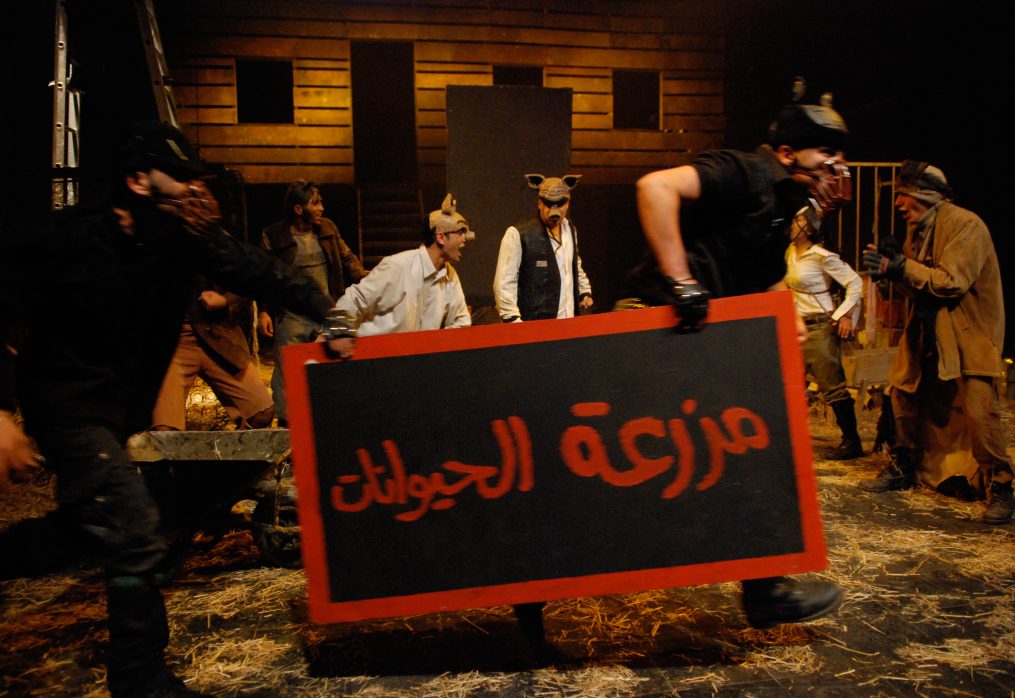
In March 2009, The Freedom Theatre presented Animal Farm, its first in-house production and the inaugural work of its newly established Professional Theatre School. Staged in Jenin Refugee Camp, Occupied Palestine, the production marked a defining moment in the theatre’s artistic, educational, and political journey, asserting theatre as a space for critical inquiry, collective imagination, and cultural resistance.
Adapted from George Orwell’s seminal political allegory, Animal Farm, the production transformed a globally recognised text into a locally grounded theatrical act. While retaining the novel’s universal critique of power, corruption, and propaganda, The Freedom Theatre’s adaptation re-rooted the story in the lived political and social realities of Palestinian society.
The Production
Animal Farm tells the story of animals who rise up against their human oppressor to establish a collective founded on equality and justice. Yet, as power consolidates in the hands of a few, revolutionary ideals are distorted, hierarchies re-emerge, and a new tyranny replaces the old. The promise of liberation collapses under the weight of fear, manipulation, and enforced obedience.
In Jenin, this narrative resonated with urgent clarity. The production drew deliberate, though never simplistic, parallels with contemporary Palestinian political life, addressing themes of disillusionment, internal fragmentation, authoritarianism, and the erosion of collective ideals. Without naming political actors directly, the staging invited audiences to recognise familiar structures of domination and complicity, encouraging reflection rather than prescription.
The final scene, where the new rulers welcome a military figure speaking Hebrew with the words “Let’s do business”, encapsulated the production’s unsettling conclusion: oppression may change its language, but its logic often remains intact.
Artistic Vision & Cultural Resistance
For The Freedom Theatre, Animal Farm was never merely an adaptation. It was an artistic intervention.
Staged at a time when Palestinian public discourse was increasingly polarised and constrained, the production challenged taboos around criticism, authority, and self-examination. It asserted the right of Palestinian artists, and audiences, to question power structures from within their own society, as an essential component of any genuine liberation struggle.
The performance ignited intense debate. It was met with standing ovations, sharp criticism, media attention, and, notably, attempts to silence it through intimidation and arson threats against the theatre itself. These reactions confirmed the production’s impact and underscored the risks inherent in cultural work that refuses compliance.
The Theatre School & Collective Creation
Animal Farm was performed by the first cohort of students in The Freedom Theatre’s three-year professional Theatre School, the only programme of its kind in northern Palestine at the time. Aged between 18 and 25, the students came from Jenin Refugee Camp, Jenin City, and Ramallah, bringing with them diverse personal histories shaped by displacement, political violence, and social marginalisation.
The production was developed through an intensive training process encompassing acting techniques, physical theatre, voice, movement, dramaturgy, and collective creation. Students were involved not only as performers, but as active participants in shaping the work’s artistic and political language.
In parallel, the production served as a practical training platform for emerging Palestinian theatre technicians, who worked across stage management, lighting, sound, and set construction, laying the foundations for sustainable local theatre infrastructure.
Audience & Impact
Over 15 performances, Animal Farm reached an audience of more than 4,500 people, including school students, university groups, community organisations, artists, intellectuals, and international visitors. Performances were consistently sold out, with audiences travelling from across the West Bank to attend.
The production sparked post-show discussions, public debate, and widespread media coverage locally and internationally. For many young audience members, it marked a first encounter with theatre as a space for political thought rather than entertainment alone.
Beyond the stage, Animal Farm affirmed The Freedom Theatre’s role as a cultural institution willing to confront difficult questions, despite political pressure, social conservatism, and physical threats.
Legacy
Staged in 2009, Animal Farm remains a landmark in the history of The Freedom Theatre. It established the Theatre School as a serious artistic project, positioned the theatre as a leading voice in Palestinian contemporary performance, and demonstrated the transformative potential of theatre rooted in freedom of expression and critical resistance.
More than a production, Animal Farm was a declaration:
that Palestinian theatre can speak to the world,
that young artists in a refugee camp can produce work of international relevance,
and that culture remains a frontline in the struggle for dignity, justice, and imagination.