The Martyrs Return to Ramallah: A Theatrical Reckoning with the Dead, the Living, and a Memory That Refuses Burial
A Critical Reading of The Freedom Theatre’s New Production Based on a Text by Walid Daqqa
By Mustafa Sheta
On the evening of May 25, 2026, The Freedom Theatre, emerging from Jenin Refugee Camp, carrying with it the wounds and unfinished questions of a community under siege, premiered its new production, The Martyrs Return to Ramallah: The Spirit’s Secret Tale, at Al-Kasaba Theatre and Cinematheque in Ramallah.
Inspired by a text written by the late Palestinian writer, intellectual, and political prisoner Walid Daqqa, the production arrived not merely as another theatrical event on Palestine’s cultural calendar, but as a major artistic intervention into questions of memory, justice, imprisonment, and the politics of the body after death.
The performance drew a wide audience of theatre practitioners, writers, artists, and cultural figures, including Sana Salama, Daqqa’s wife, and Zakaria Zubeidi, co-founder of The Freedom Theatre and former political prisoner. Their presence underscored the intimate relationship between the play and the lived histories from which it emerged.
The production itself was born under extraordinary circumstances. Unable to rehearse in Jenin due to the ongoing devastation of the refugee camp and restrictions on movement, the company developed the work in Ramallah with the support of Ashtar Theatre, whose space became a temporary artistic home. In this sense, the production represents not only a theatrical achievement but also an act of cultural solidarity and persistence.
Theatre as a Space of Meaning
To approach The Martyrs Return to Ramallah merely as a staging of Walid Daqqa’s text would be to miss the significance of what unfolds on stage. Theatre criticism begins not with the written script but with performance itself, with the encounter between text, body, image, sound, movement, and silence.
The production opens a rich aesthetic and intellectual dialogue around imprisonment, the withholding of Palestinian bodies by Israeli authorities, collective memory, martyrdom, and human dignity. At its core lies one of the most painful realities of contemporary Palestinian life: the policy of retaining the bodies of Palestinians killed in prison or by military forces, denying families the right to burial and mourning.
Written while Daqqa was imprisoned, the text transforms this political reality into a theatrical meditation on absence, grief, and unfinished return.
A Text Written in Secret
The story of this production began years before it reached the stage.
In 2021, from inside Gilboa Prison, Walid Daqqa began writing the play shortly after the birth of his daughter, Milad. The manuscript was smuggled out of prison in fragments. In August 2023, Daqqa sent a message to The Freedom Theatre encouraging the company to bring the work to the Palestinian stage.
The project, however, faced numerous obstacles: war, political upheaval, the destruction of daily life in Jenin, and the imprisonment of the production’s lead organizer. It was not until early 2026 that dramaturgical development, readings, and rehearsals finally began.
The play’s journey from prison cell to theatre stage mirrors its own thematic concerns. It is itself a story of persistence against erasure.
Directing Beyond Rhetoric
Director Mohammad Eid approaches the material with notable restraint and sophistication. Rather than turning the play into a platform for political declamation, he creates a theatrical language that moves fluidly between documentary realism, dark comedy, and surrealist imagery.
The production constructs a world where morgue refrigerators, government offices, city streets, cemeteries, and fragments of memory coexist within a single dramatic landscape. One of the production’s most striking achievements lies in its refusal to separate the political from the theatrical. The political emerges through image, rhythm, and dramatic tension rather than through slogans.
This achievement owes much to the dramaturgical work of Ghassan Naddaf, who transformed Daqqa’s dense philosophical and political text into a dynamic performance structure. Characters, ghosts, bureaucrats, prisoners, and symbols collide within a shared theatrical space, allowing the play’s ideas to remain embodied rather than merely stated.
The Detained Body and a Memory That Refuses Rest
The performance begins with the lullaby Tamahhalu (“Slow Down”), accompanying prisoners as they bid farewell to Kamal Abu Wa’er, who soon becomes another number in the prison archive.
From there, Kamal enters a refrigerated space where he encounters the ghost of Anis Dawla, another Palestinian prisoner whose body remains withheld.
This encounter forms the emotional and philosophical center of the production.
The refrigerator is not simply a morgue. It becomes an archive of suspended histories, a metaphorical prison beyond death, and a laboratory of political questions. Here, the dead do not return as supernatural apparitions seeking comfort. They return as unresolved questions.
What happens when a person is denied freedom in life and denied burial in death?
What becomes of a national movement that cannot reclaim its dead?
What happens to memory when it is transformed into ceremony?
Throughout the performance, the dead move through Ramallah attempting to make their presence known. Their demand is simple: to be returned to their families. Yet this apparently simple demand reveals a deeper institutional paralysis.
The play’s critique extends beyond Israeli policies of detention and bodily control. It also interrogates Palestinian institutions, bureaucratic stagnation, symbolic politics, and the transformation of resistance into ritualized language.
The production’s most courageous gesture may be its willingness to question not only structures of occupation but also structures of representation.
A Theatre of Political and Ethical Inquiry
The play repeatedly returns to the gap between rhetoric and action.
Terms such as “steadfastness,” “resistance,” and “liberation” are placed under scrutiny. Through satire rather than sermonizing, the performance asks when revolutionary language ceases to be a catalyst for action and becomes a substitute for it.
Daqqa’s martyrs do not return seeking mourning. They return to provoke consciousness.
They return as voices, questions, nightmares, and reminders.
Not bodies, but consequences.
Not memory, but accountability.
Scenography: Minimalism and Density
Visual artist Mohammad Al-Raee created a scenographic world built on economy and symbolic precision.
The stage remains sparse yet charged with meaning. Files, cold surfaces, spectral presences, and shifting spatial configurations create an environment suspended between realism and dream.
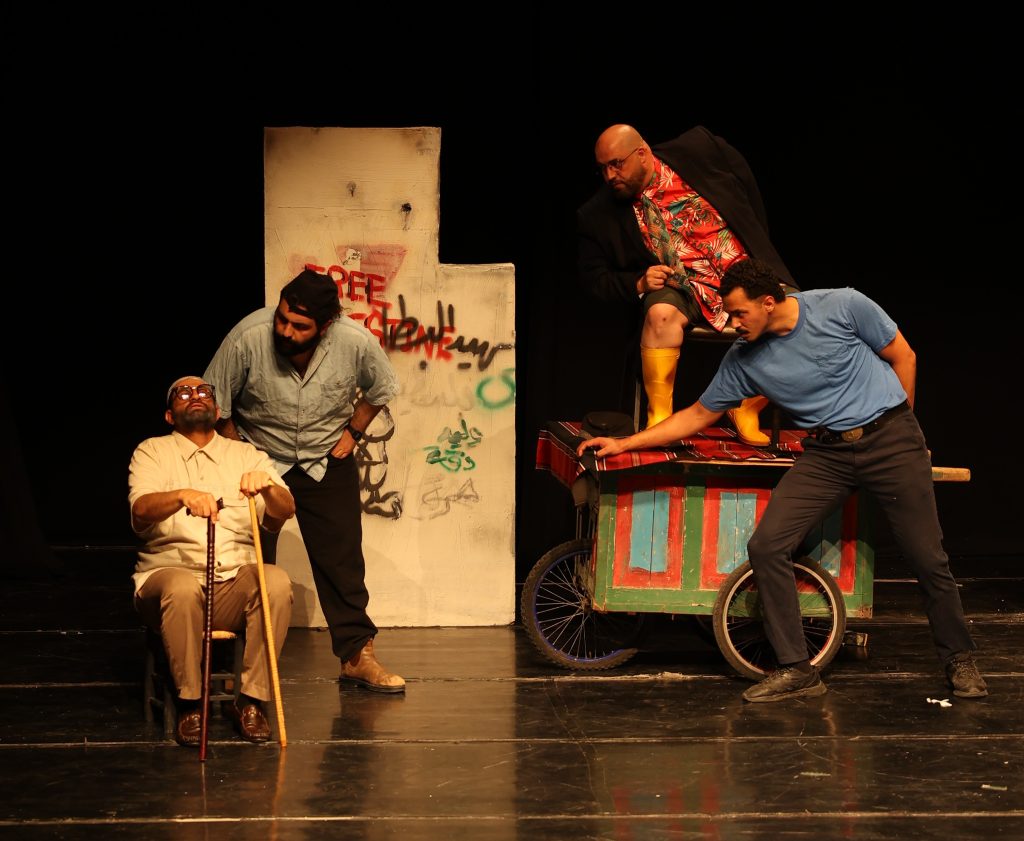
Among the production’s most effective visual devices is the recurring appearance of a simple cart, an image that theatre critic Anas Abu Aoun aptly described as “a state on wheels.” The cart functions simultaneously as bureaucratic machinery, political satire, and metaphor for an unfinished national project.
Composer Rami Washaha provides an original score that serves as a dramatic force rather than a decorative accompaniment. The music oscillates between lament and irony, between ritual and warning, reinforcing the production’s emotional complexity.
Lighting and technical design by Firas Abu Sabah further support the play’s shifting movement between interrogation, waiting, mourning, and spectral presence.
An Ensemble as a Living Archive
The production relies heavily on ensemble performance.
Diaa Harb and Raed Khattab, portraying Kamal and Anis, anchor the play through a relationship built on tension, humor, grief, and philosophical inquiry. Their exchanges transform the refrigerator into a site of both existential reflection and political accusation.
Muayad Abd Al-Samad delivers a nuanced portrayal of authority, avoiding caricature in favor of a more unsettling bureaucratic banality. His restrained performance embodies institutional power at its most ordinary and therefore most disturbing.
Ihab Abed moves fluidly between the roles of guard, investigator, and soldier, exposing the fragility of individuals operating within larger systems of control.
Tamer Tafeesh navigates a wide range of characters, from revolutionary poet to morgue doctor to cemetery caretaker, bringing elasticity and sharp comic timing to the production.
Meanwhile, Muayad Odeh’s portrayal of the “Dean of Prisoners” becomes one of the evening’s most poignant images: a man whose life has been consumed by incarceration, now trapped between heroic symbolism and institutional neglect.
Critical Reception
The production has already generated significant critical attention.
Writer Ziad Khaddash praised the work for avoiding what he called “the minefield of slogans,” arguing that the production transforms a potentially rhetorical subject into a theatrical language of suggestion, silence, and restraint.
Political analyst and writer Dr. Dalal Erekat situated the play within the broader struggle over narrative, memory, and representation, arguing that Palestinian theatre continues to function as a vital form of public diplomacy and cultural resistance.
In the Lebanese newspaper Al-Akhbar, critic Anas Abu Aoun interpreted the refrigerator as a metaphor for a suspended Palestine, caught between statehood and liberation, memory and bureaucracy, aspiration and paralysis.
Together, these readings point toward the production’s broader significance: it is not simply a play about detained bodies. It is a theatrical investigation into the structures that produce absence and the mechanisms through which societies remember, or forget.
Theatre as Reckoning
In a time marked by mass death, withheld bodies, and expanding landscapes of erasure, The Martyrs Return to Ramallah reclaims what power seeks to confiscate: names, stories, rituals, farewells, and memory itself.
The production does not merely ask whether the martyrs can return.
It asks whether the living remain capable of carrying the meaning of their return.
This is not theatre of commemoration.
It is theatre of reckoning.
A play about death that remains profoundly alive.
A play about absence that insists on presence.
A play in which the voices emerging from prison continue to speak, accuse, remember, and resist.
Supported by the A. M. Qattan Foundation through the Tahawwulat 2025 grant, the Palestinian Cultural Fund, and a network of local and international partners, the production stands as a testament to the enduring power of Palestinian theatre.
In the end, The Martyrs Return to Ramallah is not simply the return of the martyrs to the stage.
It is the return of theatre itself to one of its oldest and most necessary functions: to bear witness, to disturb certainty, and to keep alive the questions that power would prefer remain buried.